The Intentional Networking Playbook
On the flight back from the Y Combinator event at Stockholm that my good friend Hannes skillfully used as a great excuse to get me to fly over and be not-so-subtly recruited at Strawberry, I found myself in introspection about what I was left with after the main event.
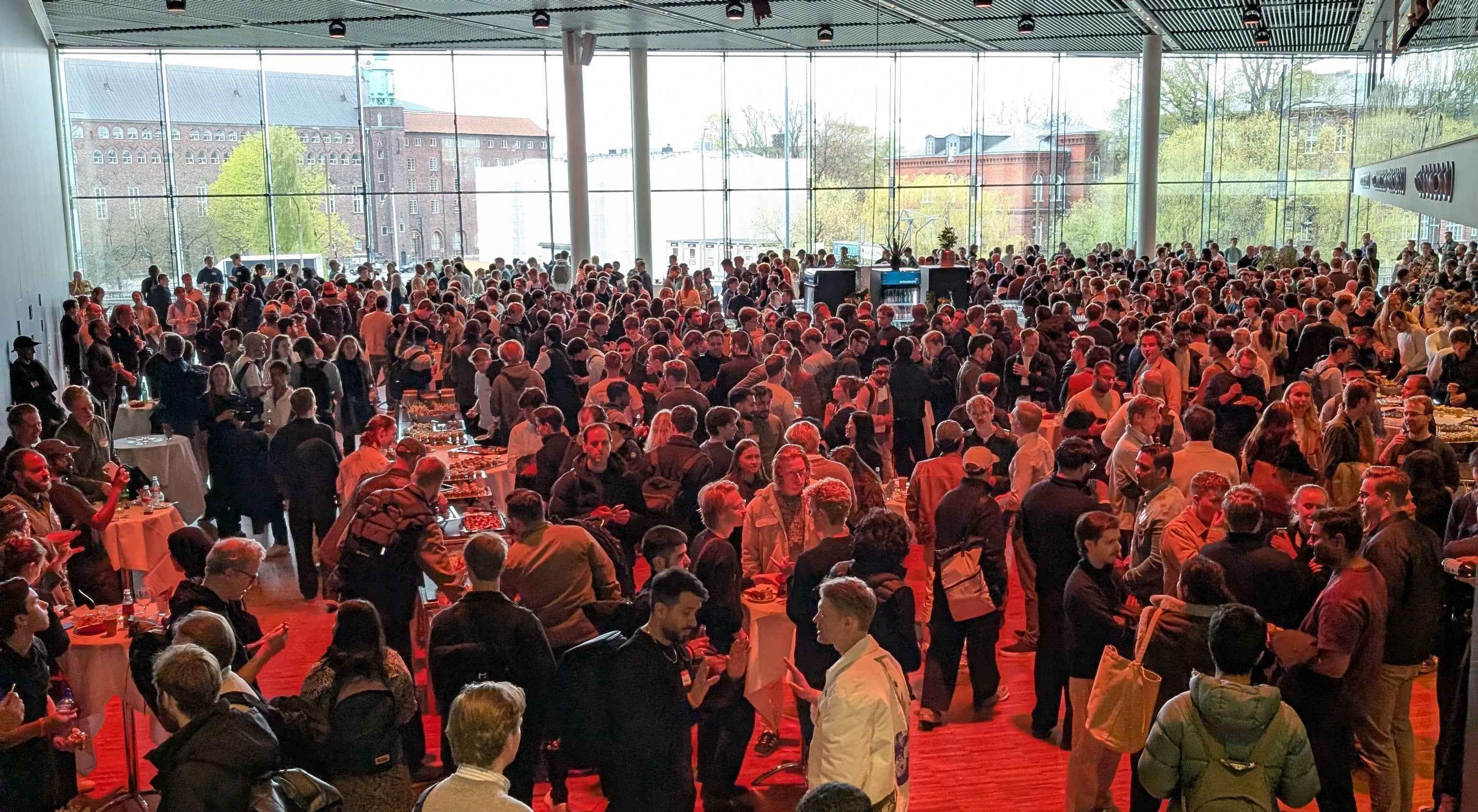
The overall trip was awesome, the city was beautiful, the people were great and it was exciting to see the energetic startup scene of Stockholm, but I was left wondering about what exactly I got from the main event itself, consisting of a couple of talks and some networking among the sea of 1300 people.
The speeches were interesting and definitely more engaging than on average, particularly with Paul Graham’s captivating stage presence, but apart from the energy in the room and the excitement of the unpredictability, I don’t typically get all that much out of the speeches and fireside chats. They rarely reveal anything new information-wise and can often be watched on the internet at 2x speed afterwards anyway.
What they do give, is a shared experience to bond over afterwards and use as an ice breaker with people wearing similar bracelets. This helps in the often much more valuable networking part right after, but why is it valuable, exactly?
Why network?
At the end of the day, relationships are the means by which everything gets done. You collaborate with the people you trust. You can only trust the people you know or those vouched for by the people you trust. When you already know great people for the function you need somebody for, you naturally gravitate towards them and when you don’t, you ask them whether they know some. This is how it has always worked and likely how it always will.
However, this network does not typically cover all your interests when you’re a generally curious person or just starting out in your niche. This is where you need networking; to discover the people in and at the edges of your niche(s) who can help, support and challenge you in it; peers, patrons, collaborators, customers, competitors, critics, co-founders, employees, employers, investors, mentors and mentees.
A strong network consisting of many trustworthy and capable people in each of the abovementioned roles enables you to improve your skills, craft and ideas in your niche, deepen your understanding, commitment and mastery of it, debate different approaches and discover more new people, ideas and opportunities that in turn unlock even more possibilities in a virtuous cycle. More concretely, it is often your network that determines your opportunities for employment, capital, political and other influence, as well as the experiences that make up the story of your life. A network interested in your skills and knowledge can enable you to monetize your passions or allow you to influence how they think about and act in the world, while knowing a local from another country can give you a much more authentic experience and show you all the secrets tourists don’t know about.
What is networking?
Though the idea of networking as who you know and who you can reach has remained the same since the dawn of the social brain, the way in which it is done has evolved significantly. For the vast majority of human history, your network was mainly your tribe. Agricultural societies enabled the formation of much more complex social networks that could meaningfully extend far further after the discovery of writing, which enabled more consistent letter exchanges. The telegram enabled near-real-time communication between set nodes of a physical network of wires while modern telecommunications technology made it instantaneous and practically location-independent.
The internet and social media enabled entirely contactless networking where the parties would never even need to meet each other. Friendships could be forged via text alone on various forums and later video calls made keeping and making contact that much more effortless. So much so that much of modern sales is sending connection requests to potential prospects on LinkedIn and talking with them via video calls on Zoom, Microsoft Teams, Google Meets or similar. Both parties might then refer each other onward to others looking to establish similar connections with nobody ever meeting in person in the real world.
This is efficient for certain types of networking and often enables connections that would not otherwise have been made due to, for example, geographical distance. However, though it enables great breadth, the depth can often be lacking. An unwarranted connection request online is much less likely to be accepted without a good pitch to justify it and the level of investment in an entirely online, transactional relationship is typically much lower than even after a random pleasant encounter in real life.
In the last few years a new dimension has been added to complicate the equation even further; generative AI has made impersonating people so much easier and cheaper that it can be nearly impossible to tell whether you’re interacting with a real person or an AI agent managing a bot account. Perhaps it’s even a real person, but working at a troll farm, scam call center or some state-sponsored social media influence operation. Furthermore, many companies are actively worsening online networking by flooding people with irrelevant mass spam and generic AI-generated slop to the degree that it is in serious danger to go entirely extinct when everybody stops responding entirely or gets off the platforms.
For now, online networking is still highly viable via 2nd degree connections, email introductions and highly targeted approaches clearly, obviously and unambiguously relevant to the receiver. Curated group chats and other invite-only online communities are becoming more prominent as means to ensure the presence of highly engaged humans and individuals with well-established accounts with large pre-existing networks and years of history can still reliably establish trusted connections between each other on almost any platform, though some platforms are significantly better at bot detection and human verification than others. There are also companies attempting to innovate in the space, such as Homie, which aims to map the warmest paths to people at the edges of your network while at Clarvo we specialize in finding and directly reaching the most relevant people in and beyond it, especially for recruitment purposes.
However, while such companies can help you reach particular types of profiles—great for use cases like talent acquisition and sales—they cannot help you reach specific individuals or ensure responses to your approaches. This separates strategic and targeted networking, where the former is concerned with profiles and the latter with people. These are both forms of goal-driven networking, which typically aims at particular objectives, such as customer acquisition, developing investor relations, influencing opinions, or increasing status. General networking is less explicitly goal-driven and more exploratory and serendipitous, under which every blind interaction where you don’t know anything about the other party can be categorized.
How to network effectively?
The evaluation of the effectiveness of networking depends on the goal, which can sometimes be perfectly measurable, such as in the cases of hitting sales targets, hiring talent or acquiring capital, and sometimes more intangible, such as when trying to influence people, building a personal brand, practicing social skills, or just meeting people for the sake of it.
Strategic networking can be done in part online, as it significantly benefits from publicly searchable profiles and is often done with a clear enough agenda for the other party to understand the reason for approach and calibrate their expectations correctly. This is suitable for goals that are somewhat transactional in nature, where volume or specificity of the profile is important and talking to people of the wrong profile would not be beneficial. However, the best method here as well is to go to places and events specially targeted at the type of people that you want to connect with. There are ones for almost any field, interest, and professional role.
For targeted networking, you need go to where the people or those in their circle are reachable. A famous person in your field will most likely never respond to a cold email unless you get very lucky, but if you make a good first impression and have something to offer, they or their friends might just remember you or let you pester their Chief of Staff or Executive Assistant. Only in person do you ever get the chance to briefly corner somebody you would not otherwise be able to reach and force them to acknowledge you.
That being said, you should not actually physically corner them nor force a superficial interaction when they are clearly not in a receptive mood for it. Both will only serve to annoy them, setting you back in your efforts. You should not waste their time or immediately jump into an unwarranted self-centered pitch either, but rather approach them openly with something they might find relevant, refreshing, interesting or entertaining. This might be a comment or question about their work, writing, experience, ideas, aspirations or activity in (social) media—the more genuine and unique, the better—, a valuable introduction you can make for them, an idea, opportunity or proposal you genuinely believe they specifically might be especially interested in, an expression of their influence on you, or just your positive energy.
You must carefully read their responsiveness and adjust your timing and verbosity to both the situation and their receptiveness. The more people they are surrounded by and the less obviously beneficial to them your approach is, the shorter you should keep it from your side. If they actively engage you, then you may extend your stay. It can often be a good idea to join an open group and listen to the conversation for a while before contributing to it. When you do, introduce yourself by name only and move directly to your point or question. Remember that high status people at events where that status is relevant may meet hundreds of people in a day.
It is difficult to sour a positively intended interaction with the first few words, but a prolonged monologue during which the other party keeps constantly glancing away impatiently can be remembered as a nuisance unless situational awareness is exercised. The peak-end rule states that people judge their experiences based on how they felt at the most intense points and at the end. This can be applied to making interactions be remembered more positively regardless of how they went overall by always ending them energetically on a positive note with a smile, firm handshake and an audible, confident goodbye timed rather a bit earlier than later.
If you have a concrete ask or something to give that they have responded positively to, or if they suggest something, ensure that you exchange the relevant contact information or receive instructions for how to contact them on the topic. If you don’t have a specific purpose you would need the details for, don’t even ask. You can try to send a connection request on LinkedIn afterwards if you like, but the important part is hopefully having established some rapport and recognizability, so that the next time is easier and more familiar. People have a bias towards familiar faces and so even a brief, positive interaction can make both sides gravitate towards each other and significantly lower their guard the next time around when you might have something more to give or ask.
A brief, positive interaction is much better than no interaction too. High-profile people are only ever somewhat reliably accessible at more or less exclusive events and in an endless sea of people getting carried away only talking about themselves, a quick high-energy exchange of just one or two sentences with no strings attached can be quite refreshing. Within the last year, I’ve often found myself in interesting situations where I have had the opportunity to talk to people that I recognize would be good to know, but I haven’t known much else about them, and so I have often utilized this principle. I never approach people merely for being or appearing famous or prestigious, but if I am interested in what they do or say in a talk, for example, and come up with something authentic to say, I will nowadays always go up to them if only to build the habit of always taking the unique opportunities.
Finally, when I first met and asked the master of the craft, evident from his and his team’s incredible success building FR8, Ernesti Sario, what his secret was for bringing it all together, his response was “If you ask for money, you get advice. If you ask for advice, you get money.”
General networking - How to start from zero and what to optimize for in networking events?
The paradox of networking is that your network is typically the smallest when you need it the most and only gets easier as your network grows. More connections bring more opportunities to make more connections that bring even more opportunities. However, many often wake up to the importance of having a network only when they would already need to leverage it for finding a job, building a team, launching a project, raising funds, gathering information or campaigning for a cause. Furthermore, networking with too explicit of an agenda can feel fake and forced, particularly to many of us Finns, and there is a slight delay from expanding the network to leveraging it, induced by the necessary relationship building and development of trust.
This is where general networking comes in. You have to build a seed network which to grow and use to create the momentum for compounding connections and opportunities. The same principles of interaction apply, but the conversations will be much more exploratory when neither party knows nothing about each other apart from what can be inferred from their presence at the place or event where the meeting takes place. This is where you will start for each new interest or field. You go to public events open to everybody interested in the topic, meet a bunch of new people, learn who they look up to, and get invited to more exclusive events where you get the chance to meet the local big names, who might eventually introduce you to more global, bigger names and so on.
In theory general networking is the easiest to do, as you just talk to everybody, but that also presents its challenges when standing in a room with 1500 other people talking with each other. Where do you start? Who do you talk to? How do you decide who to talk to? What should you optimize for? What’s the objective? Which relationships to invest into? In which ways and on what grounds?
I’ve found that I personally need to warmup to networking with one or two proactive interactions and so I often start by talking literally to the first person I see going to the event, often already on the way to the venue. From then onwards it’s less obvious. If there are speeches or fireside chats that I found interesting, I often try to chat with the speakers and also check out any stands. From then onwards it can be quite random who you end up running into. Find open groups to join or lone individuals to talk with and go with the vibe.
Everybody can teach you something and so the value you get from each interaction is a matter of how good questions you ask. This is an art always worth practicing, so there is no such a thing as a wasted interaction, as long as you focus on really connecting with another person. There is inherent value to that in itself, but regardless of the profile of the person, it also comes with the side effects of also improving your communication, observation and listening skills, making you more present, making the other person feel seen and heard, giving you a social anchor the next time you meet, and them acting as one more lottery ticket for interesting opportunities, for you can never tell who they will ultimately come from.
This is the baseline from which it can only get better; if you find common threads, pursue them for as long as you like. If, however, you feel the conversation drying up, don’t be afraid to end it—even somewhat abruptly. Same goes for if you find yourself checking out of the conversation even if the other person is still going on and on. In fact, it is probably better to try to keep interactions rather a little bit too short than too long. I certainly find myself having the latter tendency if left unchecked. The rationale is simply that it allows you to meet more people in the same time and thus have a higher chance to find those most interesting to you.
Conversations can be politely ended by waiting for the other party to draw breath—even the worst talkers will eventually have to inhale—and use the opportunity to say that it was a pleasure to meet, but you must go. Reasons need not be provided either, as those may give the impression of you eventually returning or them being invited to follow. If you feel like you still need one, going for snacks, to the bathroom, to find your friends or colleagues or my favorite in demo day-like contexts; out of fomo about getting to talk to all the demoers are all great and valid reasons. Smile, shake their hand, and walk away.
For starting a conversation, a great trick is to use prolonged eye contact after which it would be more awkward not to talk. Then talk about what you are passionate about. Ask them questions that you have been thinking about in general. You can always ask the “what-” and “how do you do” if nothing else, but asking more unique questions that you are genuinely curious to get other people’s takes on acts as a great pre-filter for people, making you way more memorable and interesting to engage with for people interested in similar topics, whom you want to find.
If their eyes light up too at the question, you know that the conversation is worth investing into, whereas if they don’t seem into it, you know it might be better to keep it short and quickly move on to the next one. You can also ask whether they know any people present that are interested in the topic as a natural way to get intros to those who you want to find, as the later into the event you are, the higher the odds of them having talked to somebody like that whom you might have missed are.
If you need to cut short a conversation you want to continue or you want to provide them the opportunity to do so, ask them to connect between the “got to go” and goodbye. I’ve been shamelessly collecting LinkedIns from most interactions at networking events, as they are a convenient way to remember who you talked with, a great way to continue the conversation and a fun metric that makes you feel like you’ve been productive with your socializing.
That being said, you must be careful not to merely optimize for what is measurable. A large network is great for finding the warm paths to people you want to connect with on Homie, but it’s not enough to just have many paths—they must be warmed up too by investing into the relationships. Focus on the people, not the number.
Be present in the moment, exchange contact information at the end or find them later, and send them opportunities, event invitations and ideas if you come across with anything that reminds you of them. In the era of AI, human relationships are more important than ever; people are still the decisionmakers and everybody craves genuine connection.
All of the most effective and impactful networking happens in-person. For quantity vs quality, the 37% rule from the secretary problem applies for general networking as well. Spend the first third of the event talking to as many people as you can and then go deeper with everybody who is more interesting to you than the most interesting person you met during the first third of the event.
Finally and most importantly, make sure you’re interesting to network with yourself. You should not let the lack of a portfolio hold you back, but if you are excited about what you are doing or building towards, much of this will come naturally to you and you will be magnetic to the type of people you want to attract, as long as you make yourself visible and accessible for them. More on this in How to find and build fantastic teams.
Happy networking!